Tuesday, July 13, 2010

St. Joseph and Danville


"Sixth day 25th [Saturday,
October 25, 1867] Rained a little last night, but not enough to lay the dust. Julia [horse] has been lame several days. Got some medicine of Martin Hutson & she seems a little better. Traveled slowly & fed 3 or 4 miles east of St. Joe, a little town on the West of Vermilion that, as some others have done, has sprung up since we passed 12 years ago. Night. Are camped in a beautiful grove 9 miles west of Danville. Felt rather lonesome till after dark. A family of movers drove up to our campfire and are now camping with us. They are Lovialls from Indiana. George used to live about Westfield & was acquainted with Uncle Wheeler & many others that we knew. Looks like rain again tonight."

"Seventh day 26th [Saturday, October 26, 1867] Rained a good deal last night, but our cover kept us dry. Got a late start. Saw beech trees this forenoon, yes & dogwoods. Got to Danville about 1 o'clock. Bought 50 cts worth of bread & 24 lbs of flour. Danville has not improved as much as some other places, tho the cars run there. Crossed the creek east of town and fed. Still cloudy & cool. Came through Dutchtown, then within 4 miles of Covington and camped by the side of a grove. After supper two men
from Kentucky stopped & camped with us. They had a wagon & half a dozen mules which they were taking to Farmington, Ill. to sell."

Continuing on Hwy. 150 from Urbana, we drove through St. Joseph and a few other small towns that were not yet established in 1867 when Ann & Henry passed through. In Danville, we discovered this stately old home. A sign near the house informed us that "a notable overnight stay at the home occurred during Lincoln's 1858 senatorial contest with Stephen Douglas... A large crowd followed him from the depot to the house, calling on him to make a few remarks. He complied by climbing out a bedroom window and making a brief speech in his stocking feet from a balcony on the second floor." I really like being in the 'Land of Lincoln'.

WHERE is Middletown?

"Fifth day 24th [Thursday, October 24, 1867] Came 12 miles to Middletown on the Sangomon & fed. Jane still very unwell. Cold raw air, cloudy. Our bread gone. Bought some in town--a dime for a small loaf. 15 cts a lb for crackers. Came through Champaign & what used to be called Western Urbana, a very large flourishing place. Eastern Urbana has improved less. Came 3/4 of a mile and camped in a nice grove in company with our Owen County movers. They will leave us tomorrow morning & turn south for Paris & cross the Wabash at Terre Haute. We shall feel lonely to camp alone again."

Looking at our map, we saw LeRoy where we had been, we saw the Sangamon River, and we saw Champaign. But WHERE was Middletown? We came to a small place called Mahomet on the Sangamon River and stopped for lunch in a corner deli. Driving around, we came upon this old cemetery in the center of town. So we had found Middletown after all! Further research showed that the town's name was changed to Mahomet in 1871 (after Ann & Henry traveled through) because of another Middletown in Illinois, and it was causing problems with the U.S. mail. Some of the headstones were placed before 1867, so perhaps Ann & Henry saw these same markers as their wagon passed this way.

Like Bloomington/Normal, we found that Champaign/Urbana sort of all ran together. It is home to the University of Illinois. Just
east of town, we came upon a present-day Quaker Meetinghouse.
I think Grandmother Ann would have been pleased.

Monday, July 12, 2010

LeRoy


"Fourth day 23rd [Wednesday,
October 23, 1867] Just a week since we left Curtis. The cars roared & steamed nearly all time of night, so we could scarcely sleep. There, the sun is up & they are hitching up to go. Nearly noon in Leroy. Came 14 miles today. Excellent roads since the rain laid the dust. Came on about a mile from town & fed at a branch where several movers were going west. Afternoon came ten miles
& camped early on the east side
of the North fork of Salt river, a nice place to carry water to cook with from town. Our Owen County travelers still with us. Jane quite unwell tonight."

Following U.S. 150, we came to Le Roy. This road seems to be the wagon trail that Ann & Henry traveled from Bloomington to the Illinois/Indiana border. We arrived in town just as a parade was ending. There were flags, families, and festivities throughout LeRoy, a charming little place.

Paw Paw bushes and Bloomington

"Third day 22nd [Tuesday, October 22, 1867] Came 16 miles yesterday. I had to lay in bed all day. Camped in a beautiful grove by a large Methodist meeting house & graveyard. Cool night. Very cool all the forenoon. Crossed the Mackinaw river. Beautiful sugar & oak trees. The little scrubby bushes we saw 12 years ago are now from 6 to 10 inches through & from 20 to 40 feet high, nice & straight. We are feeding & eating dinner by a branch 12 or 13 miles west of Bloomington. Saw some Paw paw bushes today. After dinner passed through Concord, a flourishing little place. Got to Bloomington before sunset. I think it decidedly the largest city in the west. Henry thinks it is fully 50 times as large as it was 12 years ago. We were directed on the wrong road from town & had to take the back track which made us after dark getting to a camping place. Made a fire in a lane by the side of an oak and sugar grove. Clear & cold."

Driving southeast from Morton, we crossed the Mackinaw River and headed for Bloomington. Here is a picture of the fruit of a Paw paw bush, something I have never seen in California.

We couldn't find Concord anywhere near Bloomington, but later discovered that Concord changed its name to Danvers in the 1860's. Ann calls it by its original name.

The cities of Bloomington/Normal are indeed thriving. My cousins had friends there, so we enjoyed lunch together. We found out that Bloomington/Normal is home to Illinois State University and State Farm Insurance, both major influences in the area.

The Midwesterners we have met are friendly, helpful, and really pleasant folks. Nice meeting you Bob, Bobbi, Wayne & Myrna!

Saturday, July 10, 2010

Peoria and Morton

"Second day 21st [Monday, October 21, 1867]
My back & hips
worse. Strong talk among Henry & the children of putting me on the Cars at Peoria.
Started late on account of the rain. Got to town about 9. Cars don't go out till 4. Guess I'll stick to the wagon a little longer. Saw sassafras growing last evening & today. Noon. Are feeding in company with 2 families that are moving back to Owen
County, Ind. from the west part of this state. Perhaps we
may travel in company awhile. Sun shining out now about 2 hours high. In Morton, Henry gone into the post office to put Jane's letter in to David."

In 1867, Peoria had about 20,000 people. The metro area now has a population of over 389,000. It is one of the oldest and largest
cities in the Midwest. Ann writes that because of her painful back and shoulder, there is "strong talk" among the family to have her finish the trip by train. However, rather than wait 7 hours for the next departure, she decides to ride in the wagon a little longer.


Peoria is a large, thriving Midwest city with a peaceful riverfront park. We spent some time at the river's edge watching the boats and enjoying a rare low humidity day.

Morton calls itself the "pumpkin capital of the world". Libby's has a pumpkin packing plant there, and over 80% of all canned pumpkin is processed in Morton. I'll keep that in mind when I enjoy pumpkin pie this Thanksgiving!

Friday, July 9, 2010

Peoria County

"First day morning 20th [Sunday, October 20, 1867]
Had a very loquacious
[talkative] visitor at the camp last night, a Jerseyan. Have been traveling along the railroad this morning. Came through Farmington about 9 o'clock. A nice old looking town in Peoria County. Came through Trivoli, a small village 7 miles from Farmington. Noon. Stopped to feed on the north side of a tall hedge. Camped 3 miles from Peoria on the east bank of the Kickapoo river. Rained pretty hard the latter part of the night."

These are the railroad tracks between Fairview and Farmington. It is common to find roads alongside railroad tracks or rivers. We think Ann & Henry came this way. Note the 'Yield' sign on the Railroad Crossing post. Yeah, it might be wise to yield to a train! Soon we neared Peoria and were in the middle of a large city.

Ann's next diary entry indicates a crisis with her back pain.
More tomorrow....

Cayenne Pepper in Fairview

"We are in a beautiful Sugar grove. Large trees more like Ind. than we have seen for 12 years. The children are getting walnuts along the branch. The green of the white oak & of the black oak and the yellow of the black oak & the yellow of the Sugar tree leaves make a lovely contrast. Eddie wants father to bore a hole in a Sugar tree & let him have some water to drink! A hot dry windy day though cool this morning. I have been hardly able to get up today with cold in my head and back. Came on 7 miles to Fairview, a nice little town. Bought 5 cts worth of Cayenne Pepper for my back and shoulder. Very large corn through here. O, there is a cider mill. They gave us 3 quarts, would not have any pay for it. Nearly sunset. Henry & Alson gone to a barn to buy corn to feed on tomorrow. They got oats instead of corn--3 cts a bushel. Got 2 bushels, camped in a beautiful young hickory grove. Got 15 cts worth of hay at a splendid farmhouse. Large, wealthy farmers through here. Distributed the rest of my tracts in Fairview, at a drug store where there were a great number of men & boys lounging. They were very eager to get them. I could distribute thousands of papers through here, I believe, to advantage."

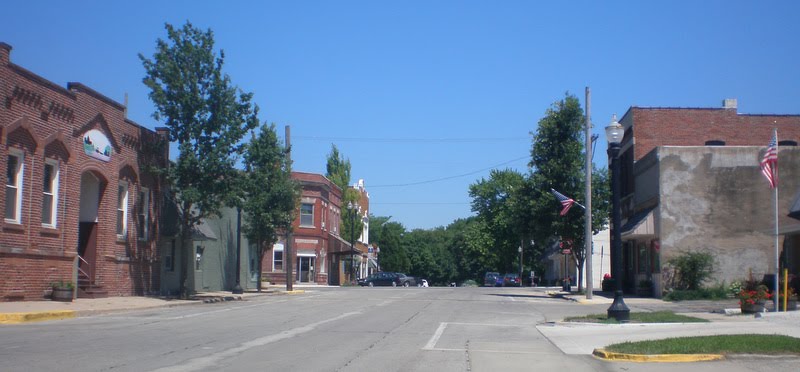
The buildings in Fairview were probably newer than the ones Ann wrote about. Still, I could almost see this feisty woman handing out her papers in front of the drug store.

Ann's back & shoulder were getting really painful. No wonder, with all the walking or riding in a wagon. I guess Cayenne pepper was the Capsaicin cream of that day!